

Hiroko Ohno: Event Horizon
Amos Eno Gallery
October 15–November 15, 2026
191 Henry St., New York, NY 10002
Hiroko Ohno’s solo exhibition, Event Horizon, at Amos Eno Gallery offers an opportunity to feel immersed in the cosmos and imagine what lies beyond our immediate perception. Ohno, a Japanese-born artist based in Brooklyn, has developed a longstanding artistic practice distinguished by a meticulous and expressive approach to painting. The gallery walls display monumental paintings depicting the universe, inviting viewers to reconsider fundamental existential questions about humanity’s place within the order and scale of the physical world.
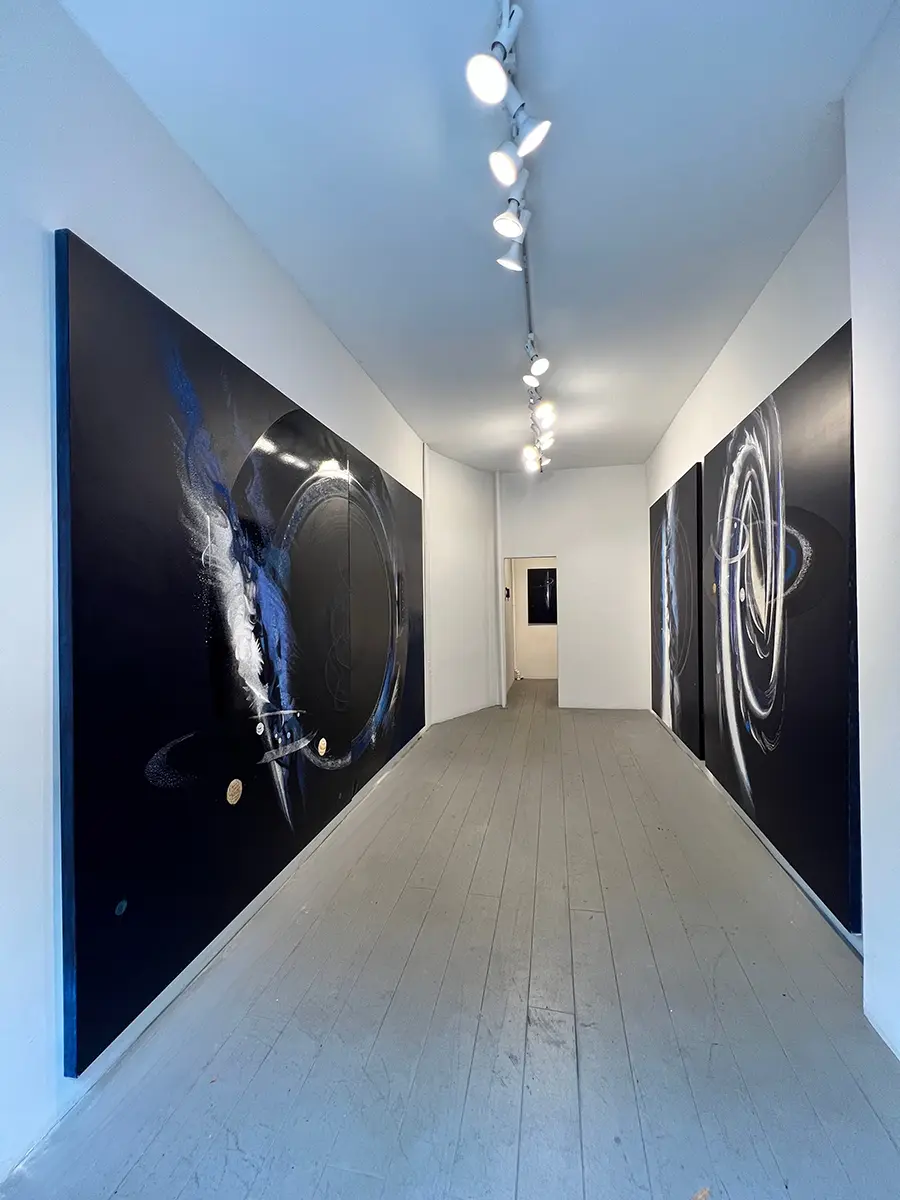
The exhibition’s title, Event Horizon, references the Event Horizon Telescope (EHT), a global network of synchronized radio telescopes that functions as an Earth-sized telescope. Ohno’s longstanding interest in the project informed the development of the diptych Galaxy: Event Horizon (2018–2021).
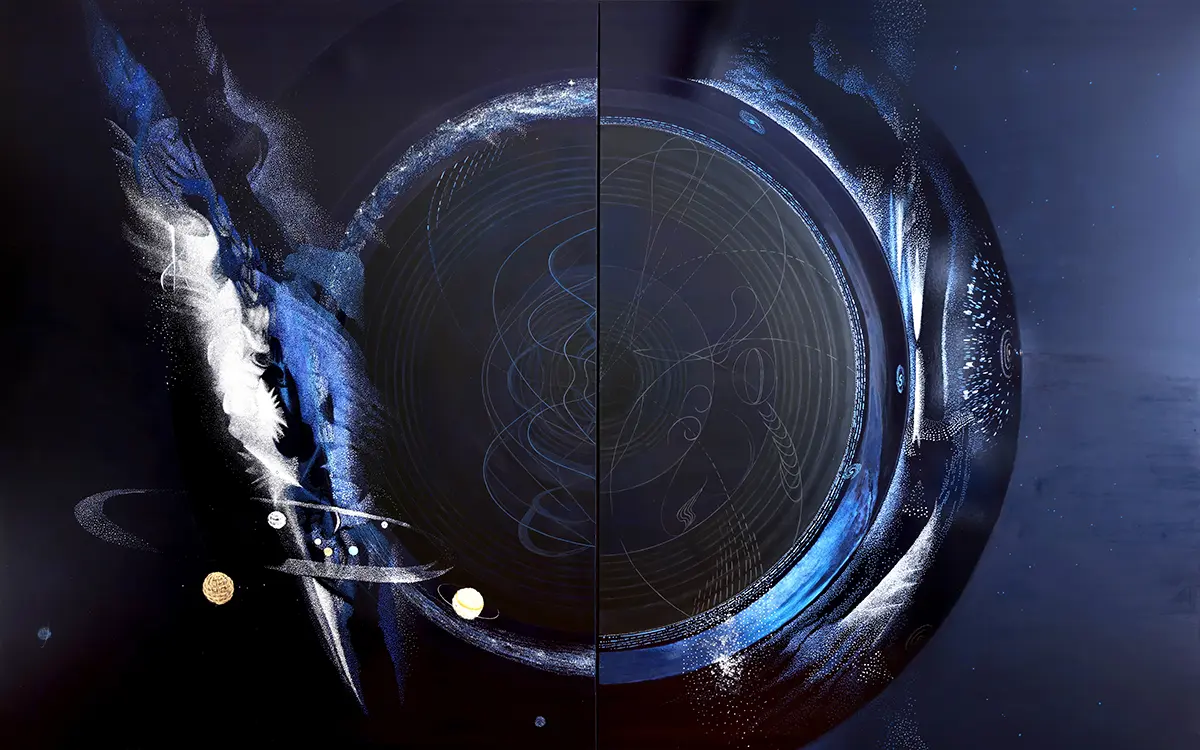
The diptych Galaxy: Event Horizon, composed of two large canvases, highlights Ohno’s meticulous approach to painting and the sustained labor behind its surface. Her devotion to her practice is evident in the depth of the cobalt blue, achieved through a painstaking process. The central circle, formed where the two canvases meet, represents a black hole. From its circumference, delicate lines extend outward, forming additional circles that do not quite connect across the two halves. A centrifugal force seems to radiate from the center, traced by countless tiny dots that create a textured surface across the canvas and evoke an immense cosmic wave. Ohno paints each dot individually with a fine brush, using pigments derived from crushed seashells, coral, and mica to create the stars. This labor-intensive process transforms the surface into a constellation of delicate marks. Against the dark background, the white dots and varying shades of blue come alive, bringing forth swirling forms and the movement of forces that coexist throughout the cosmos. The central area features delicate waves, circles, and spontaneous marks, while the left side evokes the solar system. These elements create a dynamic relationship between recognizable astronomical forms and more abstract expressions of cosmic movement.
What is most striking about the left painting is the swirl, whose sublime quality lies in its shifting colors, ranging from white to different shades of blue, including cobalt, royal blue, and sapphire. Among these shades, lapis lazuli lends the painting a particularly distinctive intensity. Ohno achieves these variations through her use of mineral pigments, whose appearance varies with the size of their particles. The finer particles produce lighter, almost whitish tones, while the coarser ones retain the intensity of the original stone. Their granular surfaces also catch the light, producing a subtle sparkle. According to the artist, heating azurite at high temperatures produces progressively darker blues and blacks, which she incorporates into her palette. These variations contribute to the painting’s extraordinary depth and luminosity.
Ohno’s Event Horizon, however, offers a different kind of encounter with the cosmos. Experiencing her work resembles looking through a telescope—there is an initial sense of curiosity, a desire to see what else might be out there, perhaps in the hope of discovering something never seen before. Or perhaps it is simply an opportunity to appreciate a beauty that we can otherwise only imagine. It may also speak to our need to feel small in the vastness of the universe. Ohno’s paintings magnify this experience, offering an expansive view in which color, scale, and intricate detail transform the act of looking into an immersive encounter.
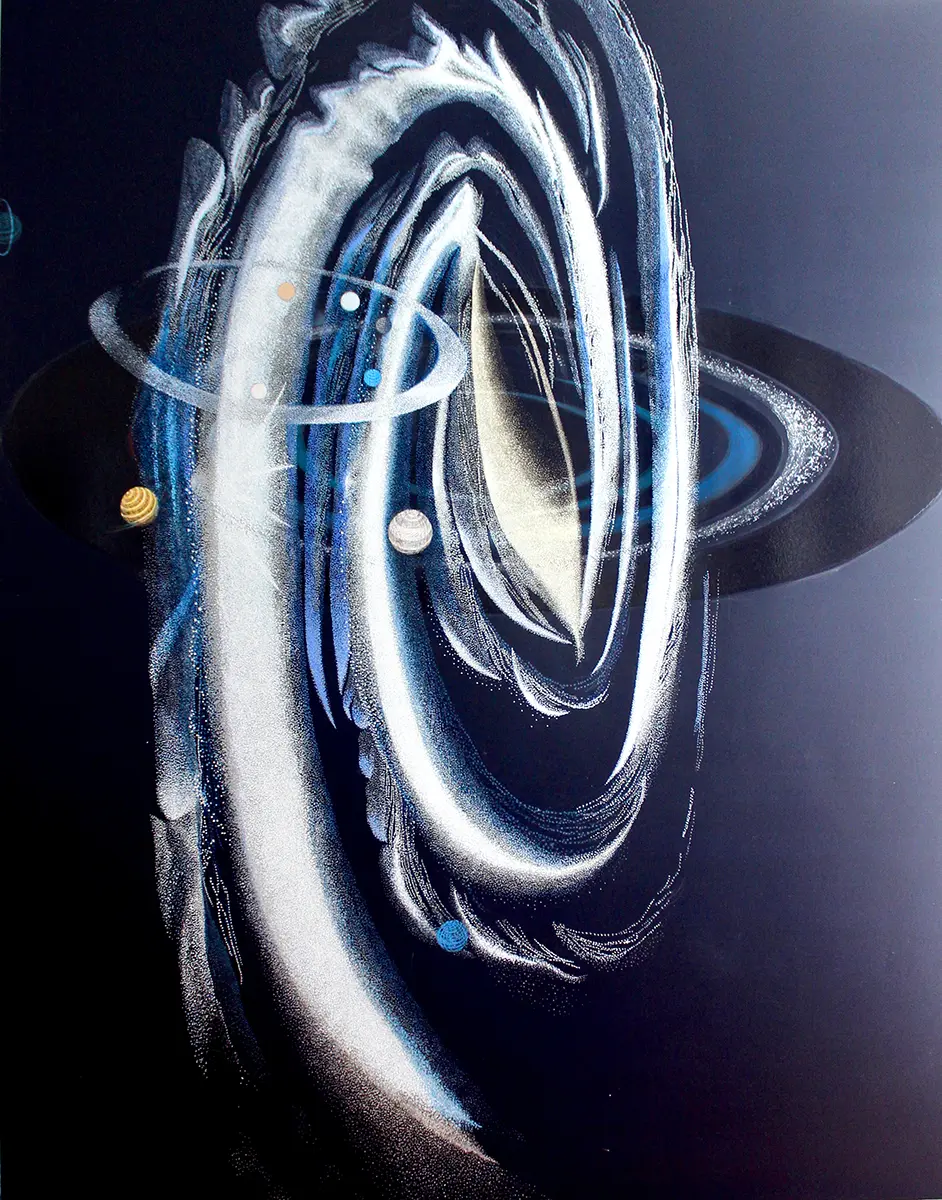
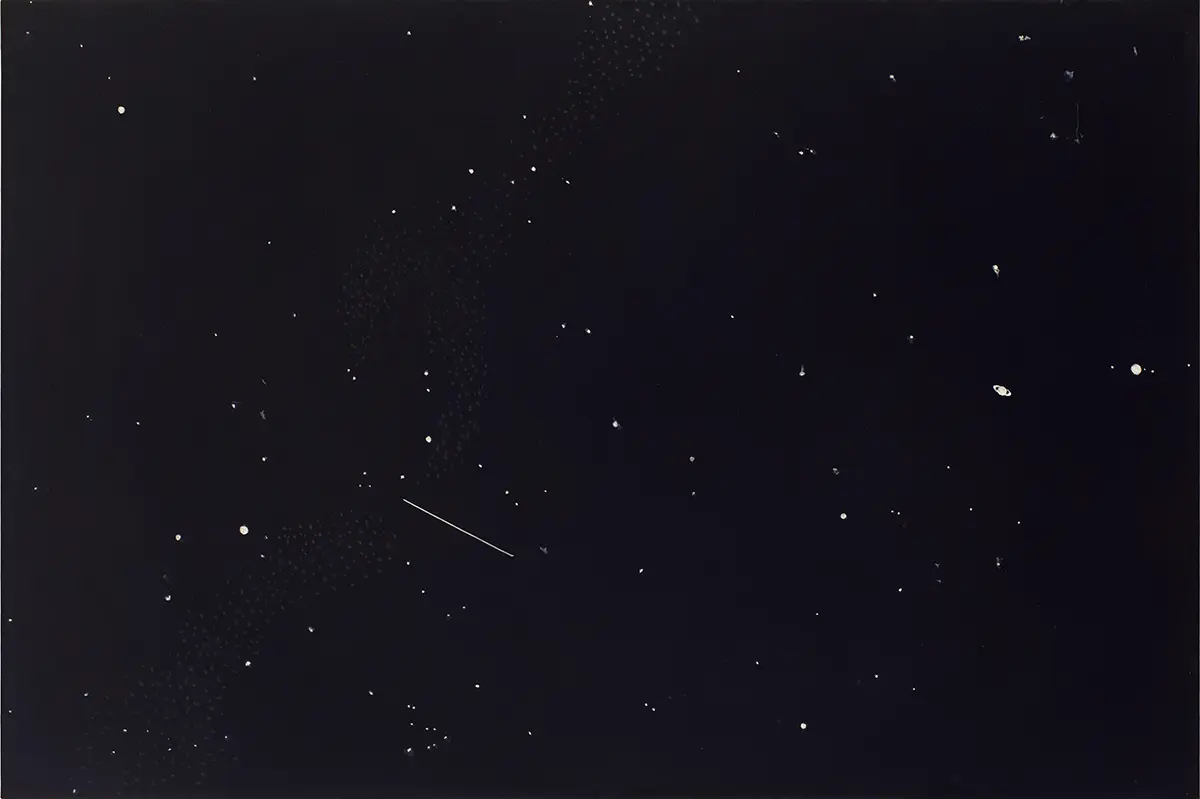
Each painting in the exhibition tells a different story unfolding within the universe. Some offer a more solitary vision, as in The Perseids in Geneva (2020), where celestial bodies appear as tiny, distant points against the vastness of space. Others, such as Milky Way (2023), convey a greater sense of movement. Its vertical spiral emerges through countless individual dots that gradually build the form and draw the eye upward. Slightly above the center, a horizontal ellipse introduces a contrasting movement, suggesting a convergence of forces that fold into one another and create a sense of balance.
The creation of this painting involves a gradual layering of color, as Ohno builds the background from pale pink to intense red before introducing successive layers of blue. As the artist notes, this process evokes the tremendous heat at the beginning of the universe and its gradual cooling into the cosmos we know today. Through this progression, the application of color becomes a material expression of cosmic evolution.
The gallery’s basement Project Space offers a different spatial dimension, featuring works with a strong sculptural quality, such as Untitled (2016), and installations including Beyond the End (2026). These works encourage viewers to move through the space and engage with the artworks in a more active and sensory way.
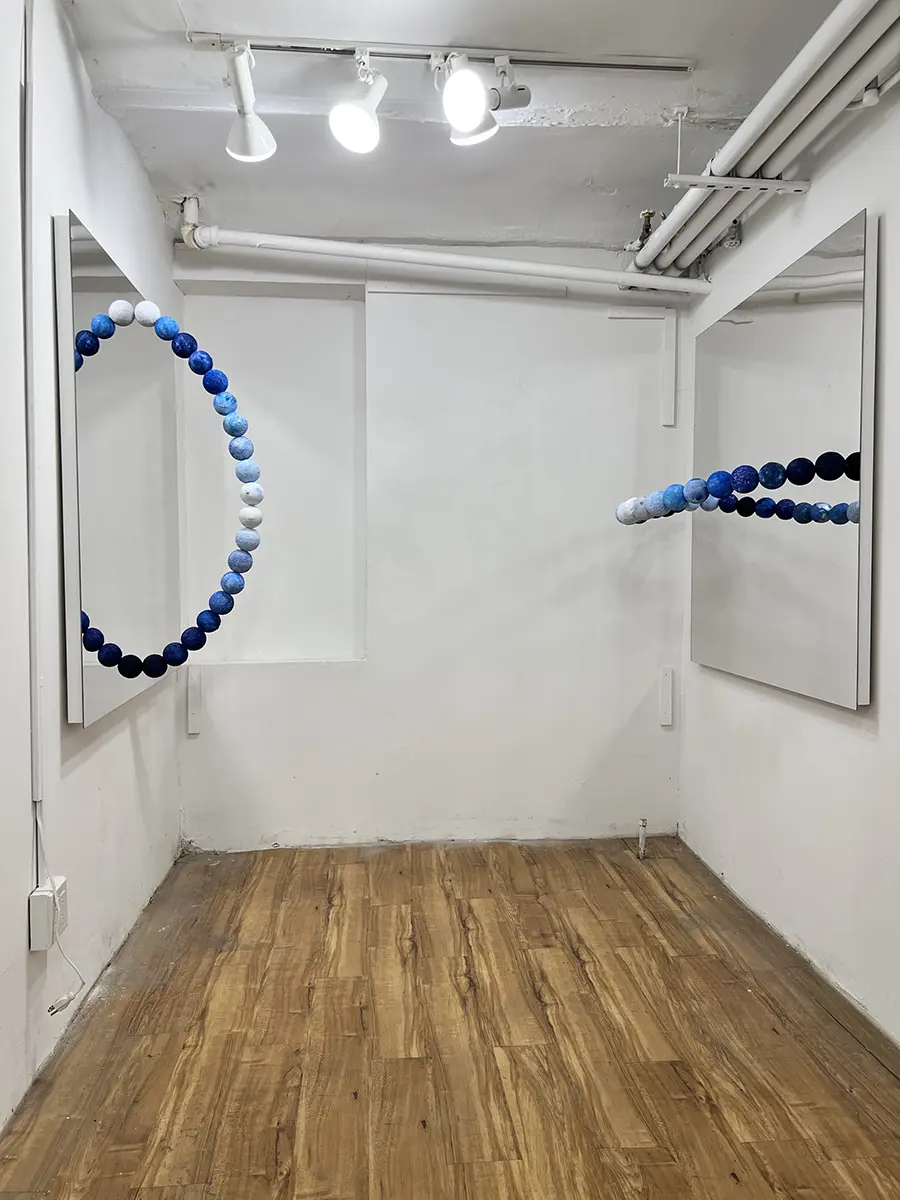
The works in Hiroko Ohno’s exhibition reveal themselves through close observation, extending the experience beyond their visual appeal. The act of looking is not static; it changes with the viewer’s position and distance from the work. Ohno creates an imagined vision of the cosmos through materials rooted in the natural world. In doing so, she brings the distant universe into a tangible, almost intimate experience.