

Ryuichi Sakamoto
seeing sound, hearing time
11.09.2026 to 20.06.2027
Hamburger Bahnhof – Nationalgalerie der Gegenwart
In collaboration with Shiro Takatani, Carsten Nicolai and Apichatpong Weerasethakul
Generally speaking, people compose music from the first to the last note following a chronological order. But today, we can for example, start in the middle, memorize it, move on to another part, memorize it.. The notion of a musical “work” has become vague. We can put these memorized parts anywhere. So it no longer has to be in linear time. It is no longer unidirectional. Rather, it’s a mass of decomposed pieces of time. Today’s musical compositions can be in any order we like. -Ryuichi Sakamoto, Tokyo Melody, 1985
When Ryuichi Sakamoto (1952-2023) spoke about music and time in this documentary by Elizabeth Lennard, he touched upon music’s ability to transform time from something linear into something tangible and malleable. Four decades later, that idea runs through Ryuichi Sakamoto | seeing sound, hearing time at Hamburger Bahnhof, the first major retrospective of his work in Europe, where seven works in five large-scale installations turn his music into spaces to move through.
Sound is a medium of memory and its emotive aspects. It can command space or surrender to silence. Sakamoto learned to take cues from the environment that surrounded him. He was fascinated by the energy and motion of the lived experience. When the environment shifted around him because of aging, cancer, the slow work of nature, and the effects of human-influenced catastrophes, he held true to his approach of non-linearity and the trembling of elements to create passage and approach. Over the course of his life, he moved from keeping time to listening to it.
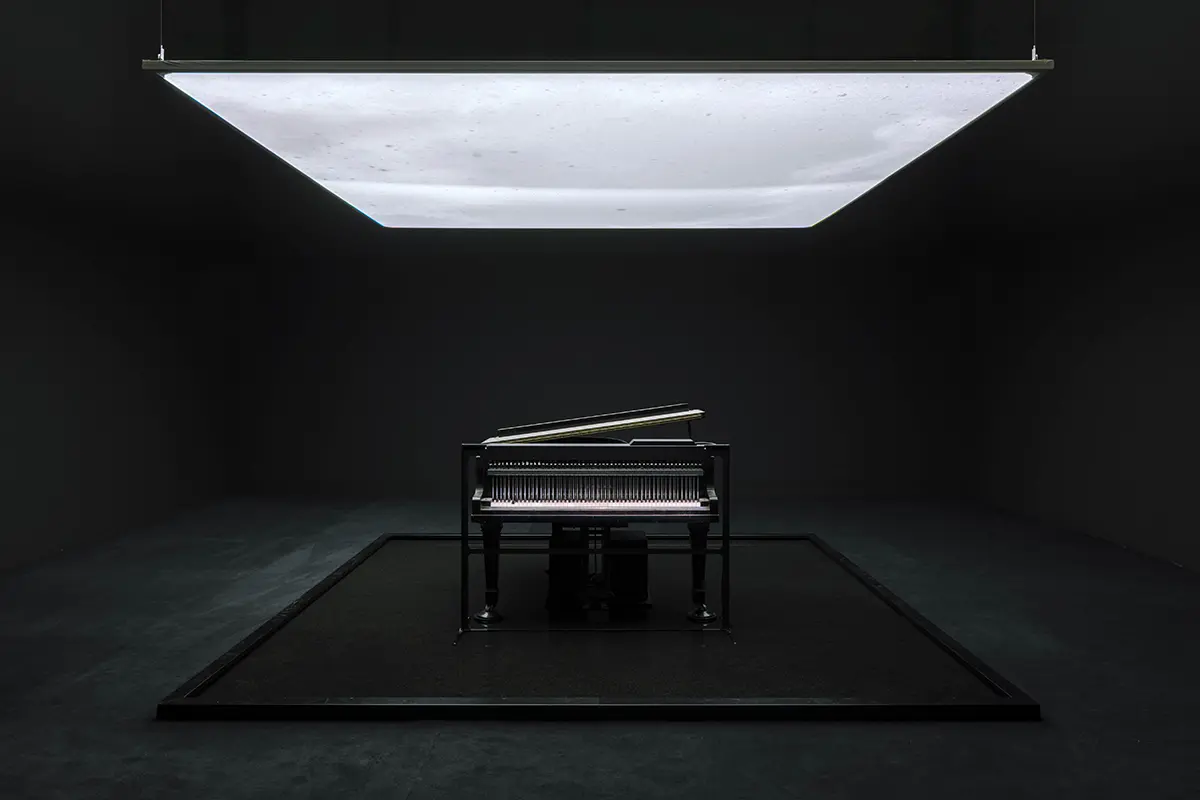
Sakamoto’s piece IS YOUR TIME 2017/2024 created with longtime collaborator Shiro Takatani centers on a piano recovered after being swept away by the tsunami following the 2011 Great East Japan Earthquake. The “detuning” of the instrument by nature is kept intact as its keys are triggered by seismic data, broken notes played for each quake. Above the piano is a screen depicting images of falling snow, the silent counterpart to the tremors generating the sound while the reflective pool that holds the piece is a gentle mirror carrying memory of its journey.
Water is an element that marks much of what Sakamoto was trying to convey in this and the subsequent works. It exists in many states, makes movement and sound waves visible, and in some ways keeps its own time. It can be seen as a shorthand for the world around us in its indifference, its necessity for life, and its capability for destruction.
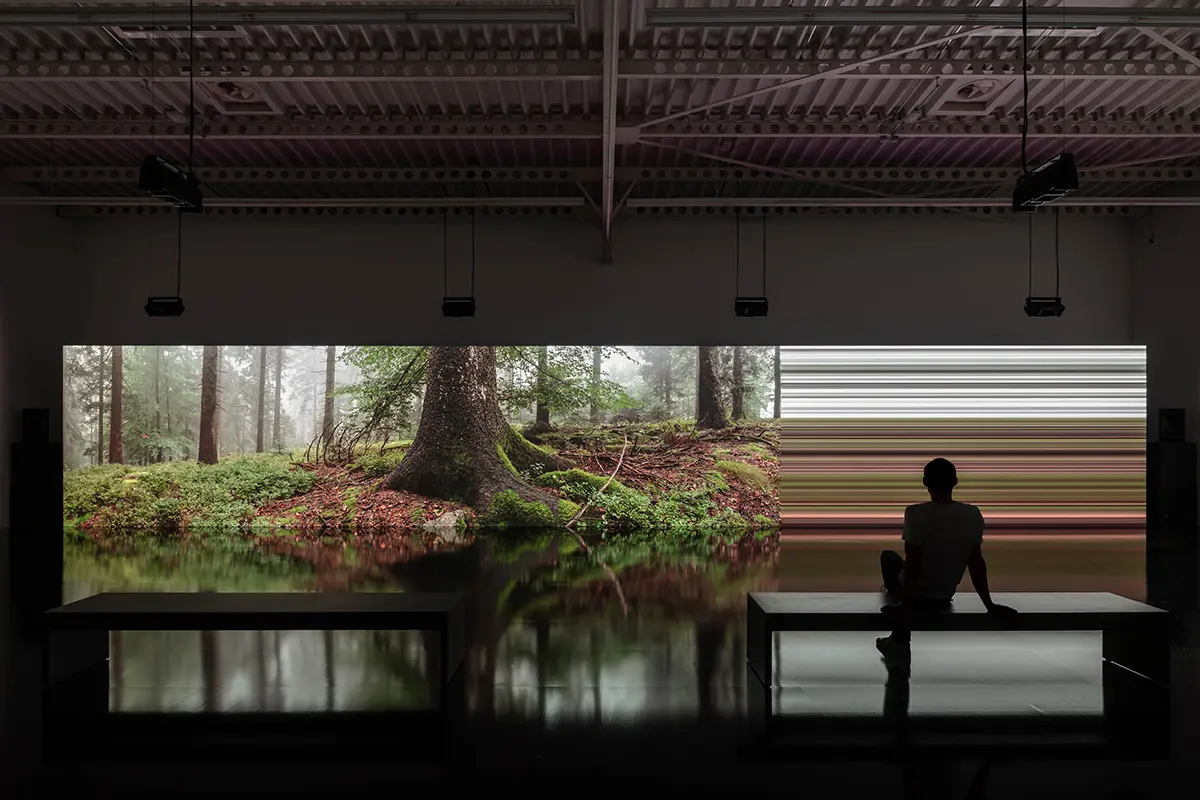
Sakamoto called this kind of work “Installation music”, music that is exhibited three-dimensionally within a space. Compositions presented as an exhibition are encountered in parts as visitors enter and exit at different intervals, experiencing the work in pieces (middle to end to beginning) rather than as a composed whole. It is the “mass of decomposed pieces of time” he described in 1985, made physical. In async-immersion, 2023 also with Shiro Takatani, (2023), the album async (2017) plays through a 14-channel sound system which completely engulfs the visitor while Takarani’s images of Sakamoto’s New York studio dissolve pixel by pixel into a motion-blur effect of horizontal lines and then re-form. Sakamoto is playing with the assumption of linearity in the concept of time and music by utilizing a score that is intentionally out of sync with the images, each operating in their own rhythm. The reflective beneath bends into a forced symmetry.
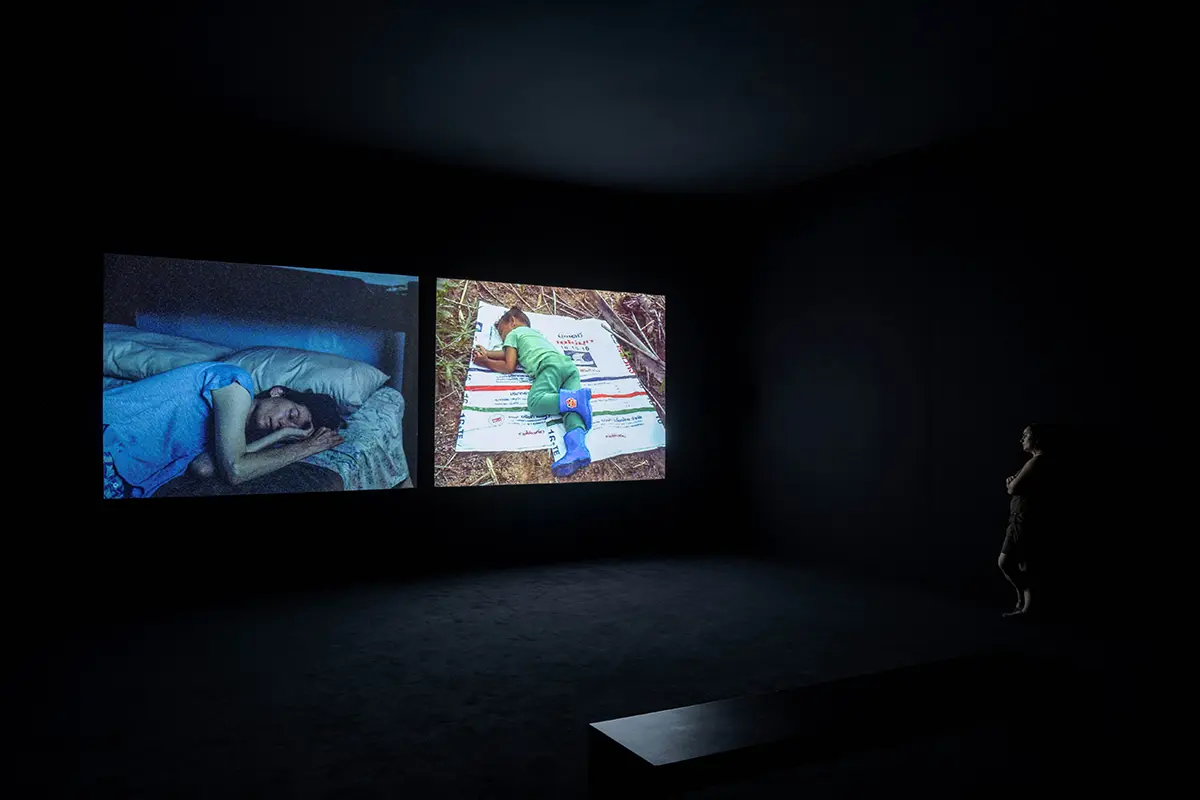
Apichatpong Weerasethakul responds to the same album in async-first light (2017). async (2017) was composed from field recordings, prepared and damaged sounds, and deliberately misaligned layers. “First light” refers to the first light of day, or the moment where the dream state becomes the waking state, the threshold between consciousness and unconsciousness. In this piece, Weerasethakul set two of its tracks to footage his friends recorded of themselves falling asleep. Filmed mostly on digital cameras, the grainy images form a veil that heightens the intimacy of the scenes, bridging the gap between the interiority and the exteriority of being while the drifts between them.
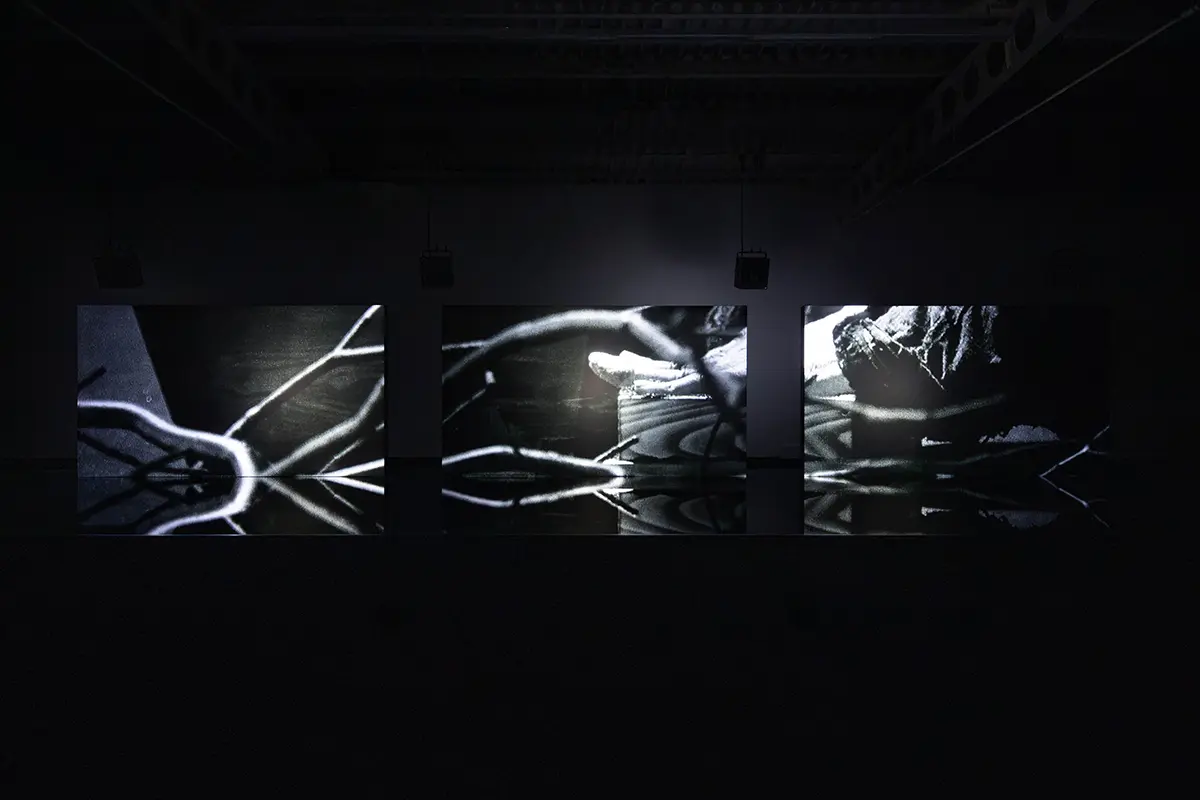
TIME, TIME, 2024 again with Takatani, draws on TIME, the theater piece by both which premiered at the Holland Festival in Amsterdam in 2021. Across three channels, Mayurri Miyata playing the shō, a traditional Japanese mouth organ and the dancer Min Tanaka recites passages from Ten Nights of Dreams (Dream #1), 1908 by Natsume Soseki (1867-1916) and from the traditional 15th century Noh play Kantan. Played in random order alongside individual image sequences from TIME, water is used again to create motion, stasis, and reflection. All three dramatic references bend time in unique ways; Ten Nights (Dream #1) speaks of faith and promise while Kantan is a tale of a long life of glory and splendor lived as a dream experienced in the span of a nap. TIME explores the contrast between human time, the meanings we attach to it, and the continuity of nature.
The two pieces by Carsten Nicolai, Sakamoto’s collaborator since 2002 carry these questions underwater. PHOPHENES, 2024 and ENDO EXO, 2024, are taken from Nicolai’s ongoing piece 20,000 (2014-present) inspired by Jules Verne’s Twenty Thousand Leagues Under the Sea (1870). Both are scored with music from Sakamoto’s final album 12, a musical diary created in 2021 and 2022 during his cancer treatment. Phosphenes are lights and colors that can only be seen with one’s eyes closed and the film moves along the borders of dreaming and waking, while ENDO EXO, from the Greek for inside/outside, reflects on the human urge to collect, catalogue, and preserve once-living creatures, an impulse Verne’s narrator shares as he classifies sea life passing the Nautilus’s windows.
Sakamoto as an artist and composer came to understand that the world possessed its own interior melody: in breath, decay, room tone, weather, the crunch of leaves. Even its silences were audible to him. His position was to find ways to synthesize it. He called himself a child of silence, or of opening one’s ears. In a 2017 interview about async he said there was no border between sound and silence, adding: “Silence is also material for music, that’s what John Cage insisted.”
Ars longa, vita brevis. Art is long, life is short. It was one of Ryuichi Sakamoto’s favorite lines and closed the announcement of his death in 2023. While it is usually taken to mean that art outlives the artist, Hippocrates meant that craft takes longer than a lifetime to master. Sakamoto’s late work holds both meanings. The music keeps playing in his absence created by a master that was still learning to listen.