

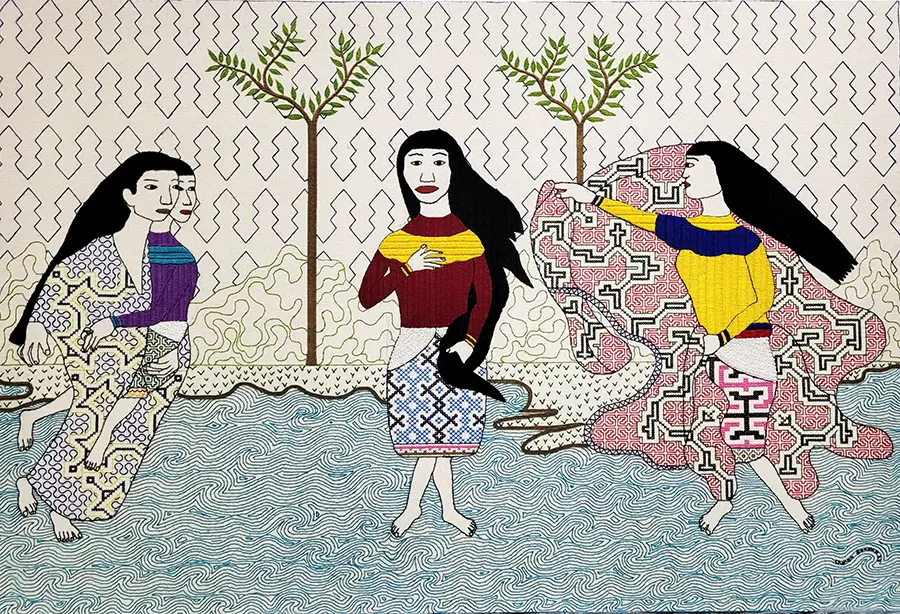
The art world is getting another major fair, this time in Abu Dhabi. The inaugural Frieze Abu Dhabi will take place November 19–22, 2026, at Manarat Al Saadiyat, bringing together 89 exhibitors from 37 countries and regions. The question is whether it can offer something more interesting than another stop on the international art circuit.
There are some promising signs. The fair puts artists from West Asia, North Africa and South Asia alongside better-known international names, with an emphasis on histories that tend to receive less attention in the dominant Western art market.
Highlights include a retrospective of Iranian artist Farideh Lashai at Leila Heller Gallery, paintings by Sudanese artist Ibrahim El-Salahi at Vigo Gallery, and a career-spanning presentation of Australian Aboriginal artist Emily Kam Kngwarray at Pace Gallery. Sheila Hicks, whose work has pushed textiles well beyond their traditional boundaries, will also have a solo presentation at Galerie Frank Elbaz.
The fair’s curated sections may offer the strongest ideas. Frieze Masters Abu Dhabi, organized by Marika Sardar, examines the Indian Ocean as a network of trade, migration, and cultural exchange. Its historical material includes Portrait L, a first-century painted portrait from Egypt being shown in the Middle East for the first time since leaving the country in 1888. The portrait’s imported jewels offer a tangible reminder that global exchange is hardly new.
Meanwhile, the Focus section turns toward younger galleries and artists dealing with migration, land, memory and colonialism. Tahir Karmali’s textile works use the language of construction to examine precarity and belonging, while Chonon Bensho draws on Shipibo-Konibo knowledge and visual traditions from the Peruvian Amazon.
Another section, Global Futures, brings together artists working across different generations and cultural contexts. Mohammed Joha’s No Shelter series considers displacement and the difference between being without a house and being without a home. It’s a distinction that sounds simple but carries considerable weight.
Of course, a press announcement can only tell us so much. The real test will be what happens when these works occupy the same space, and whether the fair’s ambitions translate into meaningful encounters rather than another round of international art-market networking.
Still, Frieze Abu Dhabi appears determined to make regional art histories central to its identity, not simply a local addition to a global brand. That is a worthwhile ambition. Now the fair has to deliver on it.