

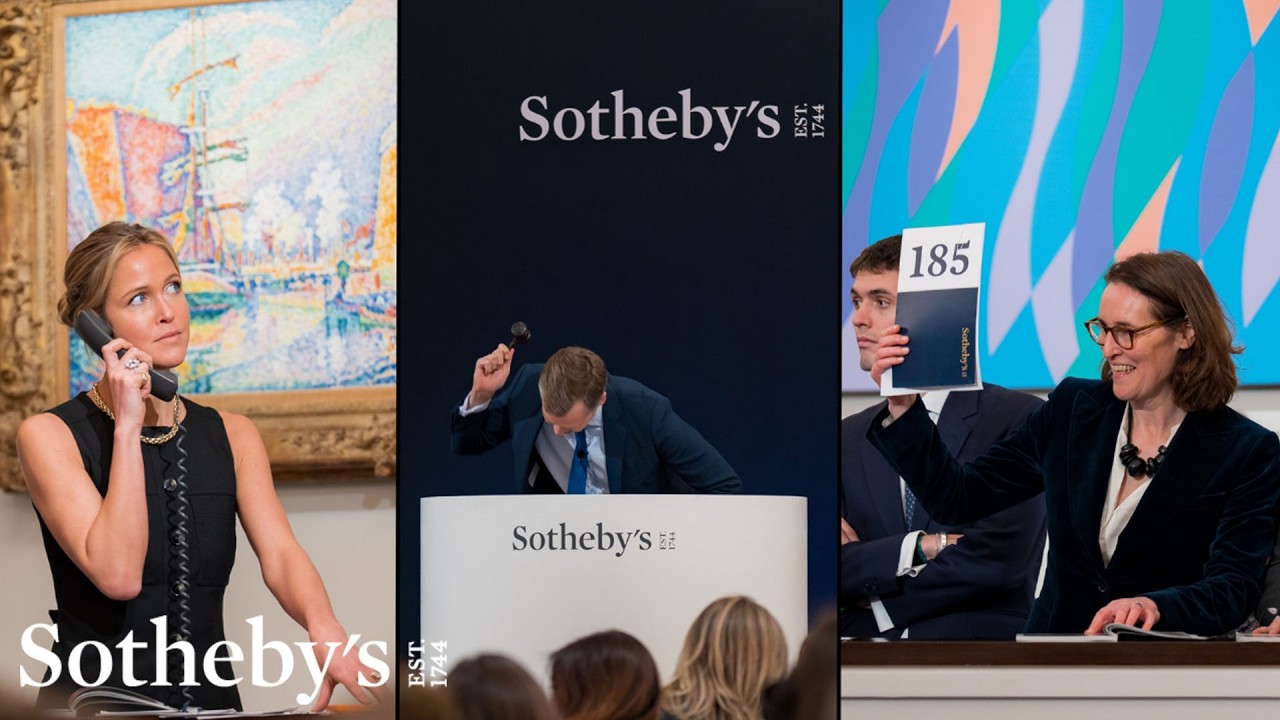
There is a particular kind of relief that settles over an auction room when the “white-glove” label is applied—a signifier that every single lot has found a home, and the gears of the art market are, for the moment, greased. Sotheby’s London evening sale this March wasn’t just a success; it was a curated sigh of relief. Totaling £154 million ($207 million), the Modern and Contemporary auctions more than doubled the results from the same period last year. It seems the jitters of 2025 have been replaced by a dogged, if cautious, return to the canon.
The star of the night was Francis Bacon’s Self-Portrait (1972), a painting that practically vibrates with the artist’s signature psychological dread. It fetched £16 million ($21.5 million), doubling its low estimate and proving that, even in a fluctuating economy, a first-rate Bacon remains the gold standard of visceral painting. It was joined by a pair of Lucian Freuds from the Lewis Collection—A Young Painter and Blond Girl on a Bed—which together commanded over £14.6 million. These are “blue-chip” works in the truest sense: tactile, historical, and reassuringly expensive.

What was most striking, however, was not just the high prices for household names but the resurgence of British figurative stalwarts. Leon Kossoff’s Children’s Swimming Pool, 11 o’clock Saturday Morning, August (1971) didn’t just sell; it soared. The painting reached £5.2 million, nearly seven times its high estimate, setting a new auction record for the artist. It is a dense, impasto-heavy masterpiece that rewards the eye with the kind of physical presence digital viewing can never replicate.
The evening wasn’t entirely without its hiccups. A Jean-Michel Basquiat, Thin in the Old, which carried an £8 million estimate, suffered from a technical glitch that forced the auctioneer to re-open the lot. It eventually hammered down at a disappointing £4.54 million. If there is a lesson here, it’s that the market’s appetite for 1980s neo-expressionism may be thinning, especially when compared to the rock-solid demand for mid-century Modernism.
Crucially, three-quarters of the works on offer were created before the year 2000. This was a sale rooted in the 20th century, leaning on the stability of Giacometti and Bridget Riley rather than the volatile whims of the ultra-contemporary “wet paint” market. The strategy worked. The room felt less like a casino and more like a museum with a price tag.

Reflecting on the evening’s trajectory and the high level of international engagement, James Sevier, Sotheby’s Head of Contemporary Art, London, noted: “The white-glove result of the evening sale and the records achieved for British masters like Leon Kossoff demonstrate a renewed confidence in the enduring value of great 20th-century painting.”
As the art world looks toward the spring season in New York, London’s March results suggest a path forward. The collectors are still there, the money is still there, but the focus has shifted. They are looking for history, for heft, and for the security of a name that has already stood the test of time.